Deep-Dive: The Roundhouse — What a Fabric Mill Becomes
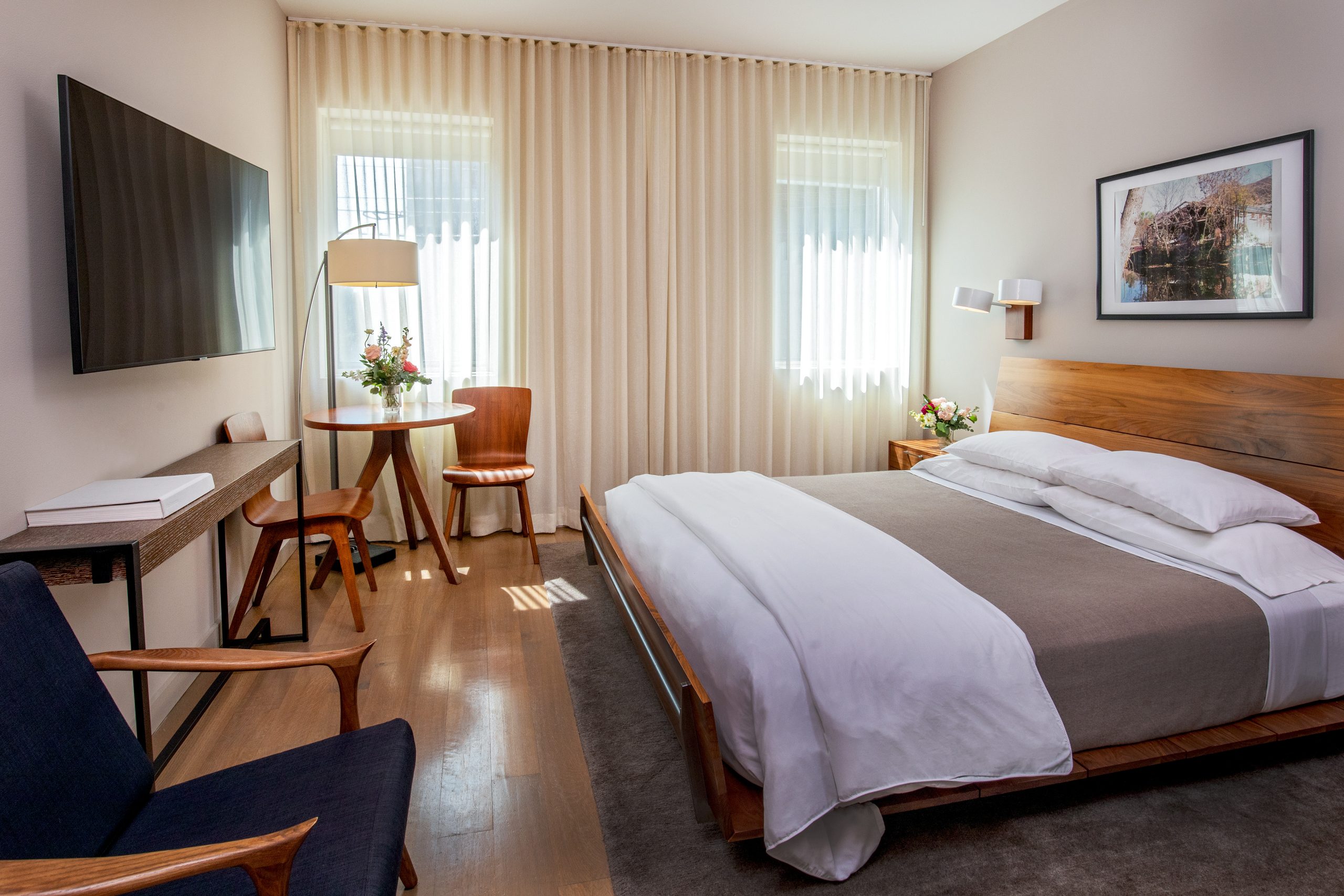
Adaptive-reuse hotels are easy to do badly. The brief — take an old industrial building, keep enough of the bones to feel honest, add rooms that work — produces a lot of half-measures. You either over-renovate (lose the building) or under-renovate (the rooms are uncomfortable). The buildings that win the brief are the ones where the new use feels obvious in hindsight.
The Roundhouse in Beacon, NY is one of the wins. A 19th-century fabric mill that sat dormant for most of the 20th century, repositioned in the early 2010s as a forty-one-room boutique hotel with a restaurant in what used to be the mill's main hall, with the actual Fishkill Creek waterfall directly outside the dining-room windows.
A decade in, here's how the property actually performs.
What it is
Forty-one rooms across multiple connected buildings on a wedge of land where Fishkill Creek drops over a multi-stage waterfall into the Hudson River basin. Beacon's Main Street — DIA Beacon, the food and gallery scene that's grown up around it — is a fifteen-minute walk. Metro-North's Beacon station is twenty minutes by foot or five by car.
The restaurant is the centerpiece. The dining room sits inside the original mill building with one wall opening onto a deck above the waterfall. There is no other dining room in the Hudson Valley with this view. The kitchen runs at a level that's reliably good without trying to be the next Wildair — closer to a serious hotel restaurant than to a destination chef-driven concept.
The rooms are spread across the original mill, a more recent connected addition, and a couple of smaller standalone buildings. The variation in room style across these is real and worth understanding before booking.
What it gets right
The site
A waterfall ten feet from the deck. That's the entire pitch and it earns it. Sitting at dinner with the falls outside the window, in any season, is one of the singular hotel-restaurant experiences in the Northeast.
The integration into Beacon
The Roundhouse opened before Beacon's full transformation into a serious art-and-food town and grew up alongside it. Today the hotel is genuinely embedded in the town — the bar gets locals, the restaurant gets non-guest reservations, the staff knows the gallery scene. It's the kind of hotel where a Saturday-night drinks-and-walk-Main-Street rotation works without ever feeling like you're a tourist visiting Beacon from the hotel.
Industrial-reuse done right
The original brick walls, the timber framing, the millrace, the proportions of the main hall — all preserved in ways that read as the building rather than as set dressing. The renovation didn't try to make the mill into something else. It made the mill into a hotel.
The base for DIA Beacon
DIA is a fifteen-minute walk. If you're doing DIA properly — a half-day minimum, ideally a full day — staying at the Roundhouse means you can do it in two visits without driving anywhere. That matters. DIA is the kind of museum that benefits from being walked into twice.
What's mixed
Room variation
This is the big one. The rooms in the original mill have the most character but are the most variable in size, light, and noise. The rooms in the more recent addition are larger and more consistent but feel more like new construction. Some rooms have direct views of the falls; some don't. The price difference doesn't always track with the experience difference.
A practical rule: if you want the building, ask for an original-mill room with a falls or creek view. If you want a more conventional hotel room with better square footage, ask for the addition.
The walk to Main Street
Fifteen minutes is fifteen minutes. In summer it's a pleasant walk along the creek. In February at 11 PM after dinner in town, it's a long, dark walk back uphill. Several travelers we know have ended up driving the eight-minute round trip rather than walking. Worth knowing in advance.
The bar program
Good, not destination. The wine list is solid. The cocktail list is fine. Beacon proper has stronger cocktail rooms (Hop, Backbar in nearby Cold Spring). If you want serious drinks, leave the property.
What we'd note
- In summer, the deck is the entire experience. Book a falls-view dinner reservation at sunset and the rest of the trip arranges itself.
- In winter, the dining room with the fireplace going is one of the best Hudson Valley winter rooms — but the waterfall freezes in fascinating partial ways, which is its own thing.
- Spring is the loud season. Snowmelt makes the falls genuinely thunderous. Some rooms hear it constantly. Light sleepers should ask.
- The hotel is a destination wedding venue. Fall and spring weekends can be partially booked out. Confirm whether your stay overlaps an event.
Who the Roundhouse is for
- DIA Beacon-focused weekenders. The walk-in advantage matters.
- Couples who want a serious dining room as part of the hotel experience without needing it to be a New York-chef-driven concept.
- Travelers who think industrial-reuse architecture is interesting and want a property that does it well.
- Anyone arriving by Metro-North. The Beacon station means you don't need a car.
- Wedding parties — both as the venue and as overnight guests.
Who it isn't for
- Travelers who want a quiet country inn. The Roundhouse is a hotel, not an inn. Larger, busier, more public.
- Travelers who want walk-out-the-door access to a Main Street. The fifteen-minute walk to Beacon Main is a real fifteen minutes.
- Light sleepers in spring. The falls are the feature; the falls are loud.
- Travelers wanting a chef-driven destination restaurant. The kitchen is good. It isn't The Henson or Wm. Farmer & Sons.
The Roundhouse vs the rest of the Hudson Valley
- vs Hotel Tivoli: Tivoli is twelve rooms and quieter; the Roundhouse is forty-one rooms and busier. Different trips.
- vs Hudson Whaler: Whaler is on Warren Street in a town with much more food density. Roundhouse has the better singular setting.
- vs Hotel Kinsley: Kinsley is more spread across multiple buildings in Kingston with no single-property setting comparable to the falls. Different category.
- vs The Maker: The Maker is the higher-design, higher-rate, smaller-room-count alternative. The Roundhouse is more of an actual hotel.
What we'd book at the Roundhouse, specifically
- A falls-view king in the original mill — the canonical pick.
- A larger room in the addition for travelers who want more square footage and don't need the original-building character.
- Avoid: the rooms directly above the bar on a Saturday in summer.
The verdict
The Roundhouse is one of the few adaptive-reuse hotels in the Northeast that genuinely earns the building it inhabits. It's not the most fashionable Hudson Valley hotel anymore — newer arrivals get more press — but it's the one whose underlying premise still works ten years in. The waterfall, the mill hall, the integration into Beacon. None of that has gotten worse. Some of it has gotten better.
Worth booking. Worth knowing which room to ask for.
Related reading
Still deciding? Tell us what your ideal stay looks like — quiet, food, design, a good town, somewhere weird — and we'll match you to a few independent hotels that actually fit.
- The best independent hotels within 3 hours of NYC — ranked by the Le Hotelist Score
- The Le Hotelist 100 — the hundred independent hotels worth knowing about
- How we score hotels — the five things we measure, and why nobody can pay to move up